Wednesday, 21 January 2015

Where are all of the engineers?

I'm biased, but I think engineers are pretty awesome. Turn on a tap and water just appears! Turn on a switch and a room is brought to light by a glowing pice of metal! Descend underground on magical moving escalators and take a train across a city! Fly around the world in something that weights 650 tonnes - not being an aeronautical engineer even I think A380s look and feel like some sort of wizardry!

WOW - engineering is essential to so much in human life. It solves every day problems with pragmatic solutions that are useable, useful and used.

People may consider engineers to:


Here's another definition:

Credit: http://www.amazon.com/ComputerGear-Engineer-Definition-T-shirt/dp/B009QR8P64/ref=pd_sim_a_11?ie=UTF8&refRID=1TE81YEM838ADXDMCQKB
So, now we have my 'unbiased' opinion cleared up (!), here's my question:

Why are there so few engineers involved in solving the problems of disaster risk and development?

The above skills strike me as a very similar set of skills that are needed in the field of Disaster Risk Reduction or DRR. To reduce disasters we need problem solvers, who can keep to a budget, who can think about future issues, who collaborate daily, who achieve results. Engineers have the attributes and inherent characteristics of the people who are needed.

So where are we?

Designing mega structures to be proud of?
Struggling for a 3% profit margin (much less than is deserved!) on city projects?
Delivering Olympic Parks?

All of these things are needed and are brilliant. But there must be more of us that care about humanitarian issues; that feel responsibility when we watch pictures on our screens of Haiti flattened by poorly designed concrete that we know, if we had designed, would have stood up and not wiped out that family. There is so much good work engineering work going on in developing countries, but there needs to be much more.

I recently attended the Pai Lin Li lecture at the Institute of Structural Engineers in London about transition shelters used by two NGOs in Ecuador and Haiti. But although these organisations are trying to provide shelter to vulnerable families, actually, they could be making them more vulnerable by providing shelter that is not engineered. And you know, engineering doesn't always make things more expensive. Actually, very often the opposite. We know how to design buildings. We know where to save on materials and where to reinforce. As a practising engineers, delivering money saving solutions is our job description!

Today I found out that Architects for Humanity are closing. Known for their great strap line 'Design Like You Give a Damn', and enigmatic founder Cameron Sinclair (here is his 2006 TED talk) this is one of the organisations that inspired me to do what I am now. So it's a sad day for them, me and for this type of work. Lack of funding is quoted to be the main issue: 

"It is that humanitarian design isn't considered a fundamental right. And that today, in San Francisco, it is easier to find funding for an app than to fund an organization which transforms lives."

So, here's my challenge. Let's stand up, be engineers and deliver engineering solutions to the developed and developing worlds. Let's 'obnoxiously insist' that things are 'done the right way'.


Here are some links to some organisations that might inspire you to get involved:


Sunday, 11 January 2015

Into the volcano: why glamourise the danger?

Into the volcano: why glamourise the danger?
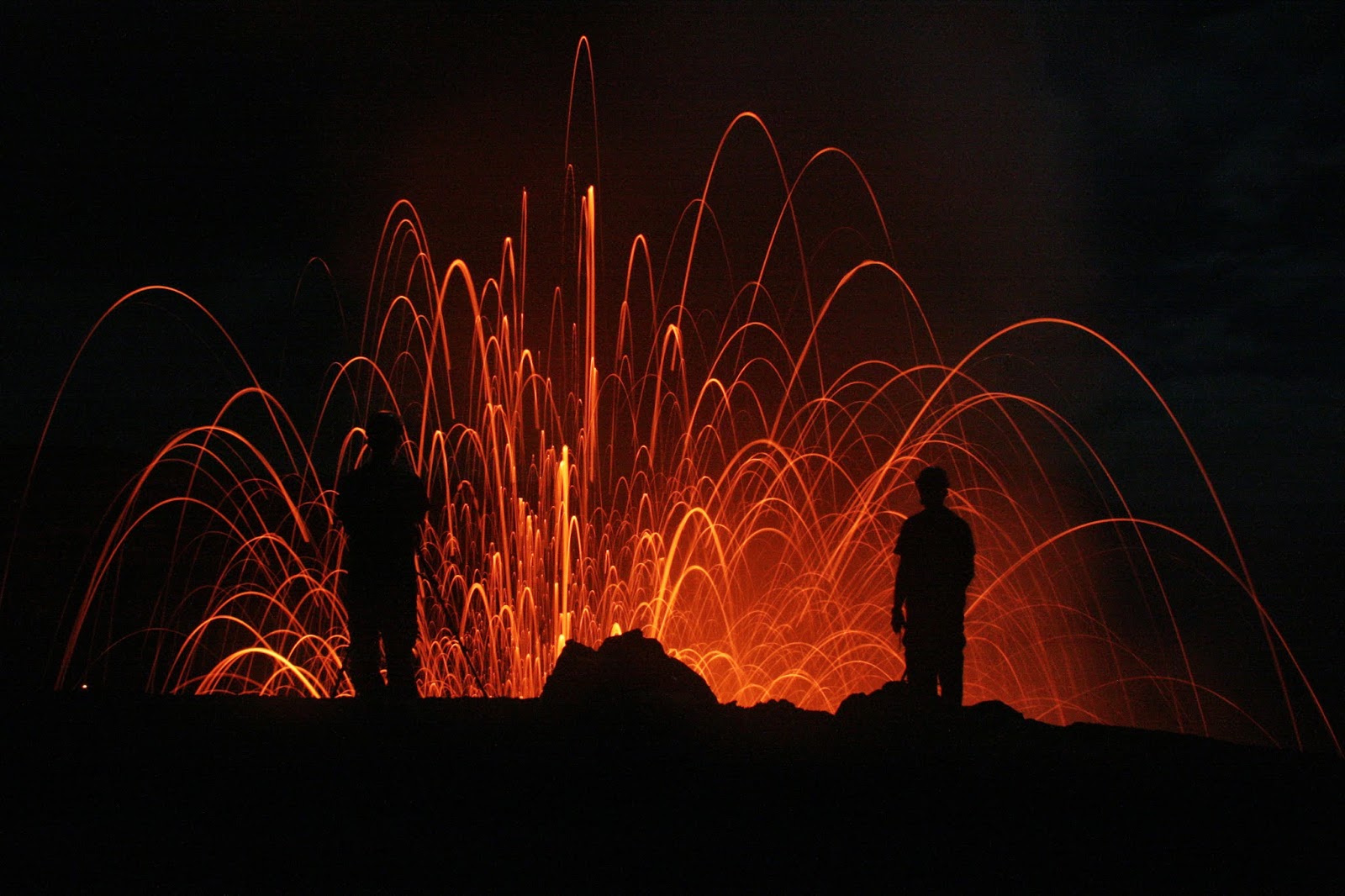
Volcanologists wearing hard hats at Yassur several years ago. Take note BBC. (Photo @volcanna) 

Volcanoes are exciting things to see. Amazing cultures exist on their slopes. They threaten ways of life around them.

Hence, they make great TV – but I was disappointed with the first episode of BBC’s Into the Volcano.

Here’s why:

1) They weren’t wearing hard hats!!

Most volcanologists wear hard hats, even on volcanoes that haven’t been recently active. It’s now common practice, much like wearing a helmet whilst cycling or on a building site. I thought that these days all volcanologists wore them (especially when close to an exploding vent!). Even the smallest of ballistics from an explosion can kill someone. I have spoken at length to some of those who helped rescue survivors following the Galeras 1993 eruption – want an opinion on hard hats…ask them!

2) I question the risk/reward of collecting the lava bomb ‘fresh sample’

Did you know that there are actually quite a few volcanologists from Vanuatu, including many disaster management professionals, many of whom I often see at international conferences. I contacted them to ask why they didn’t appear in the programme. This was part of their reply:

“what was programmed to be shown by scientists for this show is not real and is against what we have been preaching to communities here, we educate the communities to take care of themselves not to throw themselves into the volcano!!!! Therefore we [Ni-Vanuatu scientists] ended up withdrawing ourselves from this filming campaign because what is being shown is not real, we do not go into the crater to collect data!!!!”

Maybe someone can give me a wholly convincing reason of why collecting a barely warm ‘fresh' sample was worth it, compared to the other bombs that they might have collected that were much nearer?

3) Volcanoes are dangerous enough – we don’t need to glamourise the risk

Volcanoes are really dangerous. They kill people. They force communities to change their ways of life to avoid potential harm. They also kill volcanologists and tourists who visit them. I’m very unimpressed with the producers for glamourising the danger, showing scientists collecting rocks without even the most modest health and safety equipment. I’m also sad that the scientists made this choice.

Most volcanologists work to reduce volcanic risk by increasing our knowledge of them through science and learning how to work with people living near them. Much of what was in this programme was laddish behaviour that I would expect to see (and admittedly sometimes enjoy) from the chaps at Top Gear.

BBC Into the volcano went to a location with the intention of doing something that is immensely dangerous, where the local volcanologists didn’t want to be involved, for limited scientific reward; this hasn’t done much to enhance the image of volcanology as a science that primarily aims to reduce risk.


Tuesday, 30 September 2014

"I knew it all along..." - avoiding hindsight bias after eruptions

I knew it all along…” – as volcanologists, we need to be careful not to fall into the many traps that come from retrospectively looking at and indeed commenting on crises or catastrophes such as the recent eruption of Ontake.

There is a fantastic book you might want to read: Thinking fast and slow by Daniel Kahneman, which synthesises a huge body of research about how and why we make the decisions we make, particularly when it comes to risk and uncertainty. Many readers of this blog will be familiar with Kahneman’s papers, notably the 1976 “Heuristics and Biases” work with Amos Taversky. Others will be familiar with some of the work by his former PhD student Baruch Fischhoff on (among other things) risk communication*. I was planning on writing a short review of Thinking fast and slow from the perspective of what volcanologists can learn from cognitive psychology, but the eruption in Japan has got me thinking about one particular cognitive trap – the ‘hindsight bias’ or the ‘I knew it all along principle’, first investigated by Baruch Fischoff.

The key message is that as a group we must be very careful that when looking back at past eruptions, particularly when eyeballing monitoring data post-hoc, that we don’t make pronouncements about “missed warning signs” because we interpret things with the benefit of hindsight.

It turns out that it is very difficult for a human mind to reconstruct what we thought about something once we adopt a new belief about it. It leads us to believe that we understand the past, overstating the accuracy of the beliefs that we held (or would have held) at the time, as these are corrupted by what we now know. Kahneman suggests that if we are surprised by an unpredicted event, we adjust our view of the world to accommodate that surprise. Thus when we look back, we forget the state of mind or understanding that we had at the time, and simply think about what we know now.

What hindsight bias can do is lead us to interpret the quality of a decision (such as the recommendation for some kind of mitigative action) on whether the outcome was positive or negative, rather than whether or not the decision making process was sound. This bias leads us to a) overstate our expertise post-hoc, b) neglect the role of luck (or lack of it) in a particular outcome and c) suppress any memory of the effect that uncertainty will have had on our or other people’s interpretations/decisions.

Our natural tendency is to criticise decision making on risk issues when an outcome is negative, and neglect to recognise or praise decision-making when the outcome was good; this ‘outcome bias’ (a facet of hindsight) affects our interpretation of past events far more than we might realise. When considering what might happen at a volcano, a simplistic explanation is that we can consider the probability of an eruption happening given some monitoring signal [P(A|B)]. But, after an event has occurred…it’s quite different! It’s no longer an event that could happen (a chance or likelihood) but a certainty. So when we re-interpret past events, hindsight bias makes it very difficult for us in our present state of certainty, to acknowledge the attendant uncertainty before the eruption occurred. We find it very difficult to reconstruct or understand what our past belief would have been.

Kahneman suggests that these biases make it “almost impossible to evaluate a decision in terms of the beliefs that were reasonable when the decision was made”.

In fact, research suggests that the worse or more shocking a catastrophe is, the more acute hindsight bias becomes (think back to reactions in the aftermath of 9/11). This – in the case of Ontake – is reflected by language such as “failed to forecast” used in many** news articles.

So what does this mean for volcanologists in the wake of a tragedy such as the eruption of Ontake? Well, the first thing we should be aware of is that our opinions post-hoc, about what monitoring data may or may not have shown, or what decisions should or shouldn’t have been made, are prone to huge biases. So, we should be very careful what we voice about these events…particularly to the media! If we are going to retrospectively look at something, let’s do it in a robust and sensible way, such as the work by TheaHinks, Willy Aspinall and others on the 1976 eruption of SoufriĆ©re Guadeloupe.

Another point is that from afar – not being a Japanese volcanologist working on Ontake – the availability of information for us to be able make an informed opinion is surely very limited (what Kahneman refers to as the ‘availability bias’ or the ‘what you see is all there is to know principle’). So, just as we should be very cautious about talking about ‘missed signs’, we should also be aware that when we say things like ‘it’s impossible/very difficult to predict such eruptions’ or ‘there were no precursors’, our opinions are perhaps based on very sparse evidence (of course we can draw on other examples from other cases – but hopefully you get my point). In essence, maybe we could do with waiting for a little more information before passing comment.

Hopefully you get the idea that if you haven’t yet read Thinking fast and slow, then please do. It’s very difficult to overcome the various heuristics and biases that affect our opinions and decisions (even Kahneman admits to relentlessly struggling with this) …but being aware of them is an excellent first step.


 * Want to know more about the science of risk communication - read this excellent paper by Nick Pidgeon and Baruch Fischhoff 

** Not all articles/commentaries fall foul of the hindsight bias -  if you want to read some measured and not overly opinionated articles by volcanologists about the Ontake eruption – you might want to look here (Becky Williams) and here (Eruptions blog).

Saturday, 23 August 2014

New paper published!

My first ever paper has been published: http://www.appliedvolc.com/content/3/1/11

I'll write a longer blog post about it soonish. It is open access, so anyone can read!

Sunday, 29 June 2014

Behind the scenes: making a film about La SoufriƩre

You can imagine my surprise when I was the first person on a long list not too busy to head out to St Vincent to make a film about La SoufriĆØre…! Having worked on St Vincent before, I sort of knew what to expect – volcanic paradise.
The plan was to make a series of short films about the volcano, describing its recent eruptions, how people responded to eruptions in the past, and what might happen at the volcano in the future. We didn’t want to just make a documentary, or do something just for the sake of ‘outreach’ – we wanted to be able to tell the story of living alongside a volcano through the experiences of those that are.
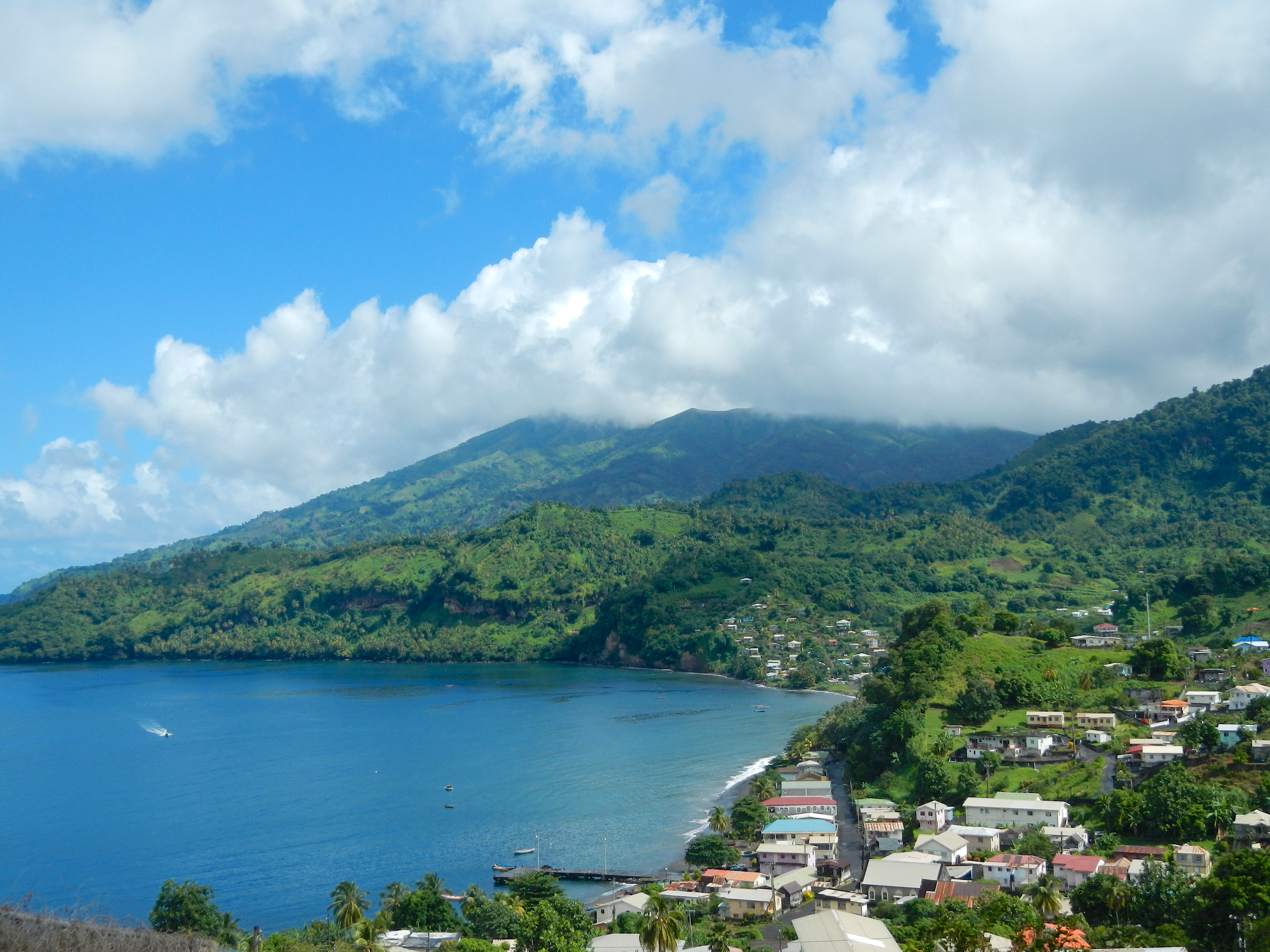
La SoufriĆØre rising into the clouds, as seen from above the town of Chateaubelair
La SoufriĆØre rising into the clouds, as seen from above the town of Chateaubelair.
For the two volcanologists, Richie Robertson (Seismic Research Centre, UWI) and I – filming in the field with a professional company was a totally new experience. Similarly, the crew from Lambda Films had yet to test their skills in either the tropics or on an active volcano.
La SoufriĆØre is an extraordinary volcano, which dominates the northern third of St Vincent. Its lush green slopes show little sign of its destructive past; the products of large eruptions in 1979 and 1902 barely visible to the untrained eye. This is a common problem to encounter on low altitude volcanoes in the tropics, as the vegetation very quickly obscures where pyroclastic density currents have burnt the landscape. Yet, with a keen eye and, of course, knowing where to look, you can uncover the signs of the past. Our first filming location with Richie was at a sugar plantation, destroyed by the 1902 eruption. Buildings covered in ash and flow deposits up to their roof, only the top of a window and the giant water wheel are still visible. Much industry like this, situated on the volcano’s slopes was damaged to such an extent in 1902, that many plantations and farms never recovered. The same happened in 1979, and although a smaller eruption, the long-term effects were felt by many.
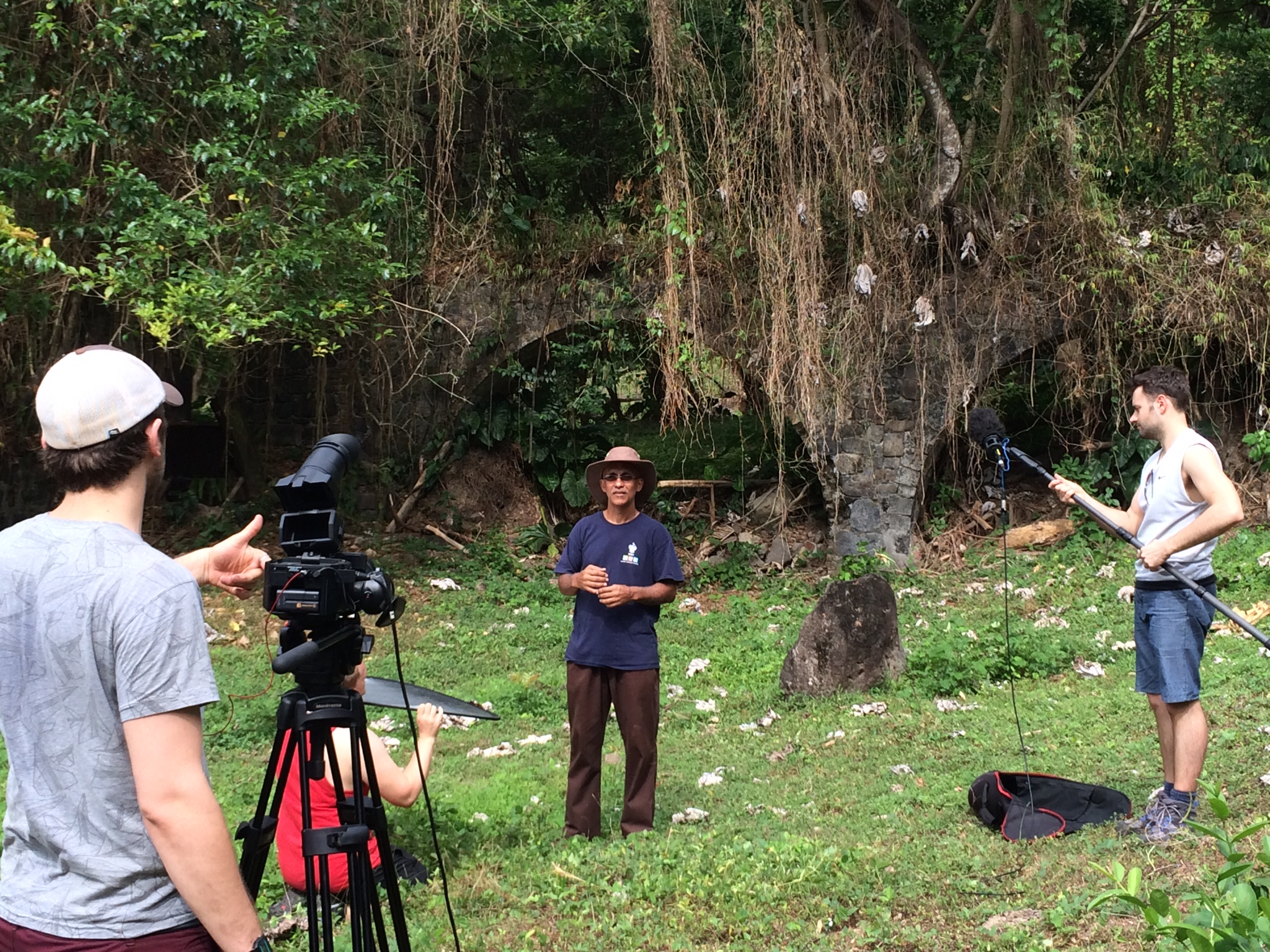
Richie describing the societal effects of past eruptions at a destroyed sugar mill
Richie describing the societal effects of past eruptions at a destroyed sugar mill.
We interviewed many people who had lived through the 1979 eruption, and they recounted their experiences for us. It’s really important for memories of past eruptions to be recorded and passed down between generations and shared with communities elsewhere in the world. Although all volcanoes are different, erupting into a vast range of social and economical contexts, many of the struggles and challenges of living with them are shared. With this series of films, we hope to show some of these challenges and how people adapted.
For a researcher who is used to interviewing or conducting focus groups, doing this from behind a camera whilst trying to get responses that would contain sound-bites for a film, was very different! I normally have a very conversational interviewing style, but the camera can inhibit this a little. However, the limitations of using a video camera became insignificant when reviewing the footage. Interviews, descriptions of past events and, most importantly, the people themselves, came to life on screen. We are sure that the footage we collected will be a great legacy for people on St Vincent.
The team interviewing a lady about the 1979 eruption, with La SoufriƩre in the background
The team interviewing a lady about the 1979 eruption, with La SoufriĆØre in the background.
As well as the interviews, the team hiked up the volcano, to film its crater and the deposits on the flanks. I had a brilliant idea to climb it at 3am – so that we could film sunrise over Georgetown, an at risk town on the eastern flanks. This ‘romantic sunrise trek’, on offer at many volcanoes worldwide, was a total fail – we could only see 10m in front of us…! Nevertheless, at the top of the volcano, any notion of vegetated slopes or a hidden past is literally blown away when you reach the rim of the crater and stare down inside. The clouds swirl and part… three hundred meters below, the crater floor expands into the distance, interrupted by a lava dome, the scale of which is indeterminable to your eyes, is then encircled by the wall on other side – over 1.5km away. A local guide, Delroy Browne, once told me that his favourite thing about climbing La SoufriĆØre is to see the look on people’s faces when they look into it. He isn’t wrong!!
The crater of La SoufriƩre, with the lava dome from 1979 in the centre
The crater of La SoufriĆØre, with the lava dome from 1979 in the centre.
To get into the crater to do our filming, we had to descend the very steep walls, with a thick rope to stop you from sliding down (probably a long way) if you were to lose your footing. The film crew with their kit, me with their water and tripod, and Richie survived the descent unscathed, and set about a day filming down there.
The team descending the crater walls
The team descending the crater walls.
The crater is so important, both physically and symbolically. The exposures of rock in the walls, showing old lava flows and explosive eruptions, tell us a story about the volcano, which is so difficult to see anywhere else. For the people of the island, the crater is a foreboding location, the source of rumor, intrigue and potential devastation. Standing in it, swirling banks of clouds often obscure the walls, wafts of sulphurous gasses coming from the many fumaroles heighten the sense of excitement. We of course unleashed both of the drones that we brought with us to get some aerial shots. Following a good morning filming, including a breakfast of hotdogs – cooked in the dome’s gas vent, we climbed back out and made our way back down.
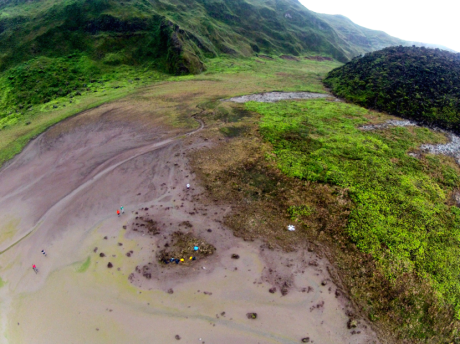
Shot from the volcanocopter of Lamba Film’s drone filming Richie Robertson in the crater
Despite having been to St Vincent before, or indeed being fortunate enough to work on many incredible volcanoes, the experience of making a film about one is something that I, and I imagine the rest of the team, will never forget. Quite what makes St Vincent feel so special to me, I don’t know.Whether it was incredible street-cooked jerked bbq food, an extraordinary volcano, some of the friendliest people you can find, a rich history or a volcanically threatened future – it has to be near the top of a volcanologist’s bucket-list for fieldwork.
Risk communication can be a tough task, in many cases it is a balancing act between communicating the right message to get people interested/concerned enough about a hazard so that they think about it and plan for it, whilst not overreacting to it. Undoubtedly, St Vincent will experience eruptions from La SoufriƩre in the future that will threaten communities and ways of life, but we hope that making and showing films like this can help to strengthen resilience there by learning from the past, and telling that story through the eyes of those that lived through it.

(This post was originally written for the London Volcano blog)

Saturday, 12 April 2014

The Inefficiency of Compassion


After a large earthquake first news comes of fatalities and numbers people affected, but soon after estimations of the cost of the disaster are reported. This figure tends to rise as time passes, however usually the economic burden is much larger with indirect losses felt in the local communities affected, such as uninsured losses, loss of income, business downtime, etc. But could all of this financial loss be, in fact, not lost and instead used to develop and strengthen resilience in communities?

I heard a story once of a factory in Asia built for use by a western company. The highly seismic area was prone to large earthquakes, so to avoid losses through downtime the factory was built to the highest standards. When a large earthquake came, the factory was in good shape and able to open the next day. However, no one turned up to work. The staff had been made homeless, lost loved ones, were injured or some even killed. From this example it becomes obvious that strengthening works, but the effects of disaster are wider spread and, in order to achieve resilience, investment and strengthening needs to consider multiple aspects.

Recently, a headline used by Care International struck me:

'Fixing the Inefficiency of Compassion'.

The article highlights the ineffective use of funds in the aftermath of disasters, when the same money could protect so many more people and therefore avoid suffering by many. A previous blog post of mine explains that 'for every $1 spent on disaster preparedness, between $2 and $7 is saved in disaster response'. There are various other values calculated by different institutions but the commonality is that it is always better value for money to invest in DRR than to spend on post-disaster recovery.

But how do we fix this inefficient spending? How to we encourage aid donations to be made when there isn't yet suffering. Is it enough to say "Your dollar will go further if you give it now, before hurricane season". Would you donate then?

The organisation Build Change is one example of a proactive organisation that aims to protect communities, instead of helping to 'pick up the pieces'. They have a wealth of technical resources, inspiring projects and opportunities to be involved.

Supporting a charity like gives you the best value for money, almost like a bargain and we all love a bargain.


Monday, 31 March 2014

Top tips for risk communicators


An amusing example of precisely inaccurate communication about volcanoes from a tourism company in BaƱos, Ecuador

Risk communication is successful if it reaches all of those who need it, is comprehended by the end user and received within a timescale that they can make use of it. How we communicate science: what we say, how we say it, who says it, why we say it, is vitally important when the goal is to help people make informed decisions. This takes a wide variety of knowledge and expertise:

“Meeting that goal requires collaboration between scientists with subject matter knowledge to communicate and scientists with expertise in communication processes—along with practitioners able to manage the process” Baruch Fischhoff 


Fischhoff - is a world leader in research on risk communication and this post is focused on a recent publication of his entitled “The sciences of Science Communication”.

Around volcanoes, and also when dealing with other natural hazards, as scientists we often can’t afford to make mistakes when communicating risk. Some do it well, some do it very badly – but it is important for the new generation of scientists working with risk communication to learn how to do it properly. We must ask ourselves: How can we not only get it right, but understand when we do, and crucially why sometimes we get it wrong.

It is true in volcanology that often the best risk communicators do it naturally. Some of this is intuitive; some of it has been learned via a vast number of experiences, including some mistakes. In this world, where we are increasingly interconnected socially, with information available at the click of a finger – we may only get one chance to communicate effectively – with so many alternative sources of information out there…we can only expect to hold the public’s attention through competence, care, integrity, reliability, fairness and openness (some of the dimensions of ‘trust’). So it is important for us to learn from those who have experience and also to get technical about it – in essence to understand the sciences of science communication.

In Fischoff’s recent paper, he describes 4 tasks for a science communicator:

Task 1: Identify the science most relevant to the decisions that people face.
Task 2: Determine what people already know.
Task 3: Design communications to fill the critical gaps (between what people know and need to know).
Task 4: Evaluate the adequacy of those communications.

Fischhoff then goes on to describe a series of mistakes, common to many instances of failed or inadequate risk communication.

Common mistakes:

·      Did they get the science wrong, and lose credibility?
·      Did they get the wrong science, and prove irrelevant?
·      Did they lack clarity and comprehensibility, frustrating their audiences?
·      Did they travel through noisy channels, and not reach their audiences?
·      Did they seem begrudging, rather than forthcoming?
·      Did they fail to listen, as well as to speak?
·      Did they try to persuade audiences that wanted to be informed, or vice versa?

So whether you are currently a risk communicator or think you may be in that position in the future, write these things down, think about them and don’t simply rely on being intuitively good at it. Don’t take my word for it – read Fischhoff’s paper  - it is really great (if you cant get it just ask me for it).


Fischhoff, B. (2013). The sciences of science communication. Proceedings of the National Academy of Sciences, 110(Supplement 3), 14033–14039.