Showing posts with label volcanoes. Show all posts

Sunday, 11 January 2015

Into the volcano: why glamourise the danger?

Into the volcano: why glamourise the danger?
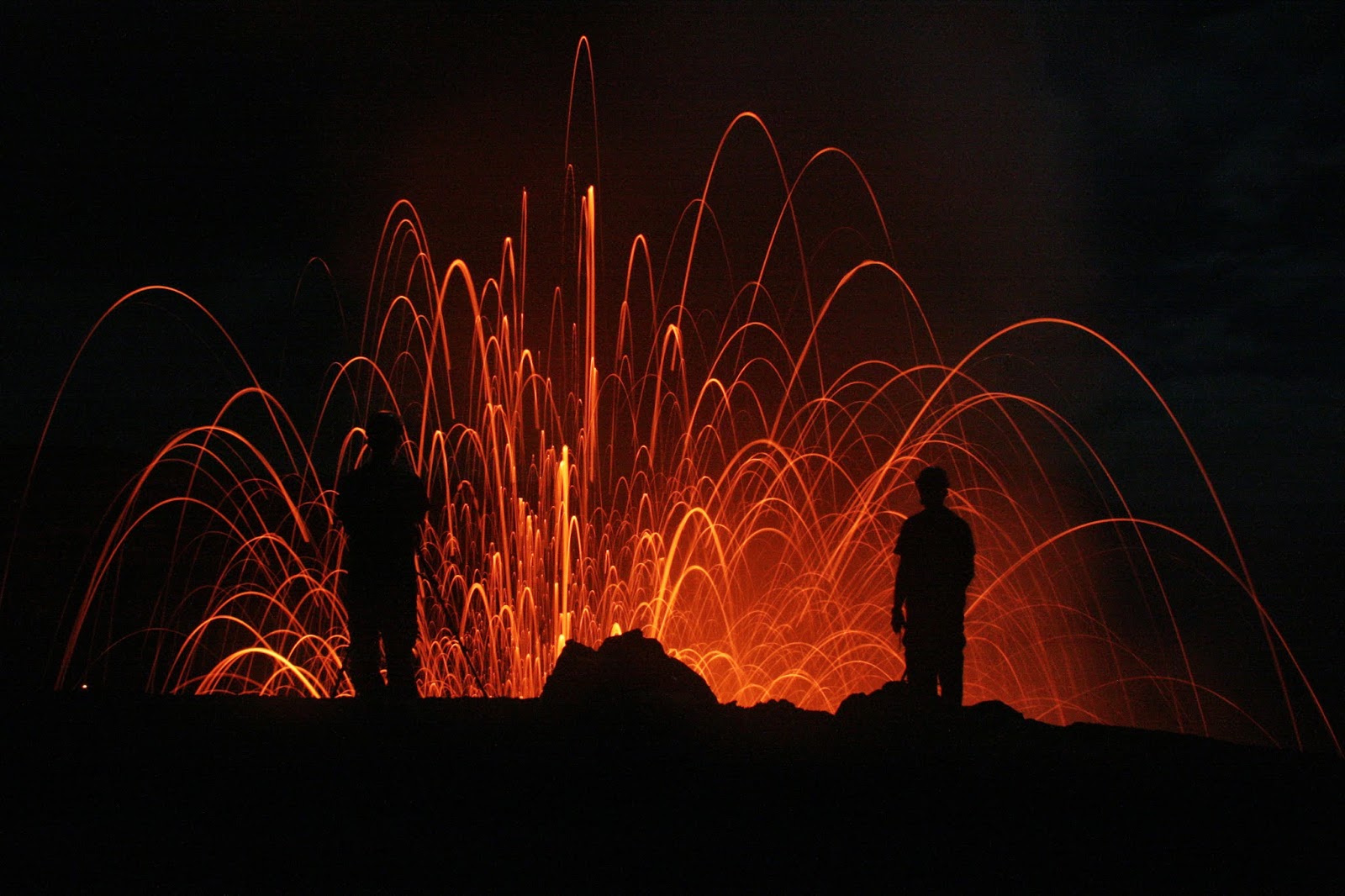
Volcanologists wearing hard hats at Yassur several years ago. Take note BBC. (Photo @volcanna) 

Volcanoes are exciting things to see. Amazing cultures exist on their slopes. They threaten ways of life around them.

Hence, they make great TV – but I was disappointed with the first episode of BBC’s Into the Volcano.

Here’s why:

1) They weren’t wearing hard hats!!

Most volcanologists wear hard hats, even on volcanoes that haven’t been recently active. It’s now common practice, much like wearing a helmet whilst cycling or on a building site. I thought that these days all volcanologists wore them (especially when close to an exploding vent!). Even the smallest of ballistics from an explosion can kill someone. I have spoken at length to some of those who helped rescue survivors following the Galeras 1993 eruption – want an opinion on hard hats…ask them!

2) I question the risk/reward of collecting the lava bomb ‘fresh sample’

Did you know that there are actually quite a few volcanologists from Vanuatu, including many disaster management professionals, many of whom I often see at international conferences. I contacted them to ask why they didn’t appear in the programme. This was part of their reply:

“what was programmed to be shown by scientists for this show is not real and is against what we have been preaching to communities here, we educate the communities to take care of themselves not to throw themselves into the volcano!!!! Therefore we [Ni-Vanuatu scientists] ended up withdrawing ourselves from this filming campaign because what is being shown is not real, we do not go into the crater to collect data!!!!”

Maybe someone can give me a wholly convincing reason of why collecting a barely warm ‘fresh' sample was worth it, compared to the other bombs that they might have collected that were much nearer?

3) Volcanoes are dangerous enough – we don’t need to glamourise the risk

Volcanoes are really dangerous. They kill people. They force communities to change their ways of life to avoid potential harm. They also kill volcanologists and tourists who visit them. I’m very unimpressed with the producers for glamourising the danger, showing scientists collecting rocks without even the most modest health and safety equipment. I’m also sad that the scientists made this choice.

Most volcanologists work to reduce volcanic risk by increasing our knowledge of them through science and learning how to work with people living near them. Much of what was in this programme was laddish behaviour that I would expect to see (and admittedly sometimes enjoy) from the chaps at Top Gear.

BBC Into the volcano went to a location with the intention of doing something that is immensely dangerous, where the local volcanologists didn’t want to be involved, for limited scientific reward; this hasn’t done much to enhance the image of volcanology as a science that primarily aims to reduce risk.


Tuesday, 30 September 2014

"I knew it all along..." - avoiding hindsight bias after eruptions

I knew it all along…” – as volcanologists, we need to be careful not to fall into the many traps that come from retrospectively looking at and indeed commenting on crises or catastrophes such as the recent eruption of Ontake.

There is a fantastic book you might want to read: Thinking fast and slow by Daniel Kahneman, which synthesises a huge body of research about how and why we make the decisions we make, particularly when it comes to risk and uncertainty. Many readers of this blog will be familiar with Kahneman’s papers, notably the 1976 “Heuristics and Biases” work with Amos Taversky. Others will be familiar with some of the work by his former PhD student Baruch Fischhoff on (among other things) risk communication*. I was planning on writing a short review of Thinking fast and slow from the perspective of what volcanologists can learn from cognitive psychology, but the eruption in Japan has got me thinking about one particular cognitive trap – the ‘hindsight bias’ or the ‘I knew it all along principle’, first investigated by Baruch Fischoff.

The key message is that as a group we must be very careful that when looking back at past eruptions, particularly when eyeballing monitoring data post-hoc, that we don’t make pronouncements about “missed warning signs” because we interpret things with the benefit of hindsight.

It turns out that it is very difficult for a human mind to reconstruct what we thought about something once we adopt a new belief about it. It leads us to believe that we understand the past, overstating the accuracy of the beliefs that we held (or would have held) at the time, as these are corrupted by what we now know. Kahneman suggests that if we are surprised by an unpredicted event, we adjust our view of the world to accommodate that surprise. Thus when we look back, we forget the state of mind or understanding that we had at the time, and simply think about what we know now.

What hindsight bias can do is lead us to interpret the quality of a decision (such as the recommendation for some kind of mitigative action) on whether the outcome was positive or negative, rather than whether or not the decision making process was sound. This bias leads us to a) overstate our expertise post-hoc, b) neglect the role of luck (or lack of it) in a particular outcome and c) suppress any memory of the effect that uncertainty will have had on our or other people’s interpretations/decisions.

Our natural tendency is to criticise decision making on risk issues when an outcome is negative, and neglect to recognise or praise decision-making when the outcome was good; this ‘outcome bias’ (a facet of hindsight) affects our interpretation of past events far more than we might realise. When considering what might happen at a volcano, a simplistic explanation is that we can consider the probability of an eruption happening given some monitoring signal [P(A|B)]. But, after an event has occurred…it’s quite different! It’s no longer an event that could happen (a chance or likelihood) but a certainty. So when we re-interpret past events, hindsight bias makes it very difficult for us in our present state of certainty, to acknowledge the attendant uncertainty before the eruption occurred. We find it very difficult to reconstruct or understand what our past belief would have been.

Kahneman suggests that these biases make it “almost impossible to evaluate a decision in terms of the beliefs that were reasonable when the decision was made”.

In fact, research suggests that the worse or more shocking a catastrophe is, the more acute hindsight bias becomes (think back to reactions in the aftermath of 9/11). This – in the case of Ontake – is reflected by language such as “failed to forecast” used in many** news articles.

So what does this mean for volcanologists in the wake of a tragedy such as the eruption of Ontake? Well, the first thing we should be aware of is that our opinions post-hoc, about what monitoring data may or may not have shown, or what decisions should or shouldn’t have been made, are prone to huge biases. So, we should be very careful what we voice about these events…particularly to the media! If we are going to retrospectively look at something, let’s do it in a robust and sensible way, such as the work by TheaHinks, Willy Aspinall and others on the 1976 eruption of Soufriére Guadeloupe.

Another point is that from afar – not being a Japanese volcanologist working on Ontake – the availability of information for us to be able make an informed opinion is surely very limited (what Kahneman refers to as the ‘availability bias’ or the ‘what you see is all there is to know principle’). So, just as we should be very cautious about talking about ‘missed signs’, we should also be aware that when we say things like ‘it’s impossible/very difficult to predict such eruptions’ or ‘there were no precursors’, our opinions are perhaps based on very sparse evidence (of course we can draw on other examples from other cases – but hopefully you get my point). In essence, maybe we could do with waiting for a little more information before passing comment.

Hopefully you get the idea that if you haven’t yet read Thinking fast and slow, then please do. It’s very difficult to overcome the various heuristics and biases that affect our opinions and decisions (even Kahneman admits to relentlessly struggling with this) …but being aware of them is an excellent first step.


 * Want to know more about the science of risk communication - read this excellent paper by Nick Pidgeon and Baruch Fischhoff 

** Not all articles/commentaries fall foul of the hindsight bias -  if you want to read some measured and not overly opinionated articles by volcanologists about the Ontake eruption – you might want to look here (Becky Williams) and here (Eruptions blog).

Friday, 24 January 2014

Sinabung & dangerous lava domes

Sinabung in Sumatra has been erupting for the last few months, prompting regular evacuations of people living near to it.


(Incandescent lava dome, flow deposit and burning vegetation - Reuters/YT Haryono)

Currently, the style of activity is producing a lava dome: where viscous (less fluid) magma builds up on top of the vent. The lava, although seemingly solid, can have a lot of gas trapped inside at high pressures, and is also still very hot. Sometimes chunks of it fall off the dome, these blocks or slabs break apart, releasing the gas, mixing with and heating the surrounding air, forming pyroclastic flows and surges.

Depending on where the lava is being emplaced on the volcano, material may fall off in different directions, thus the areas most at risk can change quite quickly. Dome building eruptions often produce a LOT of flows - the size of which can often follow a power law relationship: many small events, with a diminishing number of larger events*. Lava domes make both managing and communicating the risk very difficult. Often people are evacuated in the anticipation of larger flows, which may not happen for a while (if at all). After a time of small flows, many people naturally want to return to their homes. Then they may be evacuated again, and subsequently return. This process can occur many times, and ultimately people can become very reluctant to leave.

Unfortunately, this kind of relationship is very different to grasp.  In Montserrat, 1997, this process (among other factors) occured - the danger perhaps obvious to the scientists, but people became used to where flows were going and how big they were. Many thought that they understood the speed of them, and unfortunately thought they could escape in time. On June 25th 1997, people on the slopes of the Soufrière Hills, in areas that they were advised not to visit, were caught off guard (despite numerous warnings from scientists) by a sudden increase in the magnitude and energy of the flows during a partial dome collapse, which lead to a tragic loss of life*. 

This has unfortunately been the case in many similar eruptions, from Soufrière Hills Volcano to Merapi. An added danger is that apart from larger flows related to small collapses...lava domes can also produce large vulcanian explosions - which create even more energetic flows, that can sweep down all sides of the volcano at once.

The key thing is to not expect a volcano to always behave in the same way, but rather to think "what could it do to surprise me?".

Despite the fact that the Indonesian scientists are very capable volcanologists and communicators, we just have to hope that the eruption calms down again.


*Loughlin, S. & Baxter, P., 2002. Eyewitness accounts of the 25 June 1997 pyroclastic flows and surges at Soufrière Hills Volcano, Montserrat, and implications for disaster mitigation. Geological Society of London. 
*Loughlin, S., Calder, E. & Clarke, A., 2002. Pyroclastic flows and surges generated by the 25 June 1997 dome collapse, Sonfière Hills Volcano, Montserrat. Geological Society of London. 

Friday, 10 January 2014

Risk perception…not the only important thing?


Why would you live here?! Nestled near the bottom of the Vazcun valley, these homes are in a very high risk area on the slopes of Tungurahua, Ecuador.  Built on top of pyroclastic flow deposits, which have regularly impacted the area in historic times. There hasn't been one to this location for almost 100 years - so despite heightened activity since 1999, people are still here. Sadly - unless the volcano becomes extinct (not likely any time soon) - history will inevitably repeat itself. I just hope not in the near future....

What if I told you that my friend lives there...and his family extended their house...only a few years ago - i.e during a time when the volcano was erupting? What would you think? Would you suppose that my friend and his family don't really know how dangerous the volcano is? What if you then found out that my friend is a very promising volcanologist...? Why on earth would they live there and invest money in their property as they surely know the volcano is very dangerous?? 


I regularly find myself telling people that I am a little dismayed that a ‘risk perception study’ is often the first social science approach taken off the shelf by volcanologists. When we are considering risk reduction, what we want to know is how people might respond to a hazard or forecasted hazard, and what steps they are likely to take to reduce the risk to themselves and their family. How people perceive risk or the ‘potential danger’ from a volcano is important, but it shouldn’t be the first thing we investigate and for me, it doesn’t explain adequately why people might take certain decisions or actions when confronted by risk.

Perhaps I trivialise the issue, but here is one interpretation of what a typical risk perception study is probably looking at:

Survey question: How dangerous do you think the volcano is? 

Answer: not very

Solution? Educate them about volcanic hazards. If they knew how dangerous it was, they wouldn’t live or work there, or they would at least make sensible decisions when we tell them something.


We could even add in a quantitative element – because that of course allows us to really understand something:

Survey question: on a scale of 1- 10 , how dangerous do you think the volcano is? 

Answer: 5

Solution: oooh – if we can educate them so that their answer is the same as our answer (about 7) then they will be safer. Risk Reduction

In reality, the problem here isn’t actually about risk perceptions – it is about what we think they might tell us:

Thinking that people can have ‘bad’, ‘incorrect’ or ‘wrong’ risk perceptions isn’t helpful – it assumes that we all have the same way of calculating risk, or that there is some objective ‘true’ risk.

Assuming that we can ‘change’ or ‘improve’ people’s risk perceptions, to bring them more in line with scientists’ perceptions is a concept from straight out of the idiots guide to educating knowledge deficient publics:

The deficit model  of risk communication– suggests that the lay-public will make irrational decisions based on limited information about a problem.  This comes about because scientists often only consider objective science as the most important information. Whilst the amount of knowledge that the lay public has is a factor in their response, we have a responsibility to not disregard other factors as irrelevant. I very much doubt that we deliberately do this…but our obsessive focus on people’s risk perception doesn’t pay much attention to other things that might influence their decisions – as we know that the public’s judgments of risk aren’t necessarily based on the amount of information that they have, but more often than not on their ‘world view’, their social or political views and their circumstances*.  None of us, even scientists, simply process information with associated heuristics and biases, and then make a decision. We aren’t machines. Rather we like to attach meaning to issues. Further to this…much of how we make sense of the world is actually not individualistic, but a socially constructed reality. Particularly in volcanic areas, knowledge and meaning about risk is transferred between social groups, often passed down between generations. 

People create social representations about risk – reaching a consensual understanding of what did or could happen – we build common sense about an issue by anchoring and objectifying it. We anchor by drawing on shared experiences from the past, making an unfamiliar issue familiar amongst our group. Then we often objectify things, by representing them in a way that is easier to grasp, using more familiar terms. For example, people often objectify ash plumes, which are lit up and incandescent as “smoke and fire”. It may be different to the scientific reality, but anchoring and objectifying is the way in which social groups make sense of new or unfamiliar situations. For example, the way that a social group might have been affected in a previous evacuation and how they have made sense of it, may have a far greater effect on decisions they will make in a future risky situation. Thus, their risk perception of a volcano might suggest that they know it is incredibly dangerous, but if the community only talks about how last time there was an evacuation, they were looted or lost their animals, then how dangerous they perceive the volcano to be may have little baring on their decisions. If we simply asked them how dangerous the volcano is, we will get a false positive answer.

Where risk perceptions focus on knowledge and information, risk representations focus on meaning and understanding. What is more useful for us as volcanologists to know? How or why people might behave in a certain way, or what they know, which may or may not then affect how they behave?

I'm not suggesting that we don't try to understand risk perceptions - but let's try to not make it the first thing that we do. Instead what we could be looking for isn’t how dangerous people think a volcano is, but what do they think about it in relation to other hazards or life situations. When we frame the problem like this, we are able to attach meaning to people’s views about volcanic hazards - and then you can understand the factors determining why my friend and his family live where they live. 


To read more about social representations of risk, have a look at the paper below as a starter by Helene Joffe. Sorry if you can't access it...

Joffe, H., 2003. Risk: From perception to social representation. British Journal of Social Psychology, 42(1), pp.55–73.

*This is based on the work of Paul Slovic (among others)

Monday, 20 February 2012

The ‘social’ geologist
“The social geologist - thinking about people and not just rocks” 
As a young undergraduate, I used to love going out into the field - swinging my hammer at any outcrop foolish enough to show itself to me. Whilst I wasn’t as hammer happy as some of my peers (“Jackhammer” Jake in particular), there seemed to be so much rock out there, and too many samples to collect. I can distinctly remember though, standing on a desolate beach in Somerset on a windy afternoon, being told we were not allowed to hammer at rocks here, as the sight was a SSSI (Site of Special Scientific Interest). This was probably my first introduction to geologists having an obligation to preserve things, even at small scales such as this. 
 As geologists we have a responsibility to do things sustainably, to preserve and in some cases protect, whilst making the most of the world that we live in and it’s resources. This obligation, or responsibility, doesn’t stop with the natural environment and it’s feelings or preservation, but also to the people that live in it. Can the people be more important than the resources or the scientific research? Of course they can and indeed they are - a fact that can often be overlooked. 
But why, as geologists, should we be bothered about people? Isn’t that what geographers or social scientists do? I remember having some disdain for “Jackhammer” Jake, famed for his rock smashing prowess, when he switched courses from geology to Environmental Geoscience. It was almost as if the word ‘Environmental’ made us ‘pure’ geologists shudder. Jackhammer however, was just ahead of the curve and spotted a trend that we should all take note of. It is impossible to divorce the world of science from the public’s impression of it, and so we really do need to keep people in mind when we plan our next research, exploration or extraction. I’m not calling for everyone to become social scientists,  not every geologist needs to go out and interview people (please don’t just go out and do a questionnaire to tick this box), but all of us need to at the very least, engage with those that do try to listen to or understand people (social scientists) and we need to keep an open mind. 
Half way into my MSc, I worked at the Montserrat Volcano Observatory in the role of scientific communication and outreach. I had gone out there to work at a volcano observatory, hoping to do some quantitative volcanic risk assessment work if the volcano started to erupt, but ended up learning profound lessons about the intersection of people and science. Heightened activity in December 2009 meant that we were no longer able to give sufficient warning to some people in a particular community there, and so the authorities took the decision to evacuate them. Residents there were quite unhappy with the decision to evacuate and in some cases angry. The decision was based on sound scientific evidence, so why didn’t people understand? I was perplexed, but just tried to continue acting professionally. Only later, having acquired some social science research training and returning to Montserrat, did I manage to talk to some of the residents and understand from their point of view why they were so unhappy with the evacuation. What may have seemed black and white to scientists, did not seem that way to the residents. You see, we are all people with emotions, feelings and opinions, but we sometimes forget this when we are being professional scientists. We then manage to divorce emotion from our thinking and in some cases decision making, instead relying on pure logic. Clearly from a practical point of view it is sometimes necessary to act with cold logic, but we should be aware of the other dimension, so that we can at least understand, even if it sometimes does not change the decisions we make. 
People, us scientists included, have opinions and feelings, based on a vast many things. Some opinions may seem ‘wrong’ scientifically, but are they any less valid? The ‘social geologist’ doesn’t need a social science degree… they need to stop and consider the opinions of others before they smash the rock with their hammer, sink a new well or evacuate a village. They are aware of the importance that people and their voices should have in decision making, and strive to be inclusive. If you read the news or articles in scientific journals, our world is facing an uncertain future, in terms of climate, competition for resources or increasing vulnerability to natural disasters. Scientists can’t answer and fix these issues on their own, so we need to include and listen to the public. We can no longer hide inside a lab or behind a computer screen but rather we should make concerted effort to engage with and communicate to people who’s lives we affect with our decisions.